Yulong Guanyin 御龙观音 Copperware Bodhisattva Statue – 21cm or 30cm | Chinese Guanyin with Dragon for Home Altar, Meditation Room, Tea Room & Meaningful Gift


Yulong Guanyin 御龙观音 Copperware Bodhisattva Statue – 21cm or 30cm | Chinese Guanyin with Dragon for Home Altar, Meditation Room, Tea Room & Meaningful Gift
Yulong Guanyin 御龙观音 Copperware Bodhisattva Statue
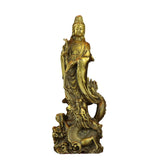
A sculptural Guanyin / Avalokiteshvara figure standing above a dynamically coiling dragon-and-cloud base. Flowing robes, a calm upright posture and the powerful lower dragon composition create a ceremonial vertical silhouette suited to home altars, meditation rooms, studies, tea rooms and curated Chinese cultural displays.
Available Sizes
- 21cm: approx. Ø7 × H21cm; weight about 0.75kg.
- 30cm: approx. 30cm overall height, with a proportionally broader dragon-and-cloud base for stronger visual presence.
Material & Finish
Presented as a copperware Guanyin sculpture with a warm aged-gold finish that highlights the robe folds, dragon scales and cloud details. The antique-style surface gives the piece a traditional devotional-art character without requiring a heavily ornate surrounding interior.
Guanyin & Dragon Imagery
Guanyin is one of the most widely recognized bodhisattva figures in Chinese Buddhist culture and is commonly associated with compassion and attentive care. Dragon imagery adds a dramatic, auspicious and guardian-like visual element. These meanings are cultural and devotional rather than guarantees of supernatural outcomes.
Placement & Styling
The 21cm size works well on compact altar cabinets, meditation shelves, tea cabinets and study credenzas. The 30cm version is better suited to deeper altar furniture, living-room sideboards and more formal display niches. Pair the warm metallic finish with walnut, rosewood-toned furniture, black lacquer, cream stone, linen, celadon and soft directional lighting.
Home Altar & Meditation Room
If the statue is used devotionally, place it on a stable, elevated and respectful surface according to the household’s own Buddhist practice. Different traditions use different arrangements, so the figure can be integrated naturally with the room rather than following a single universal compass rule.
Gift Guide
A meaningful gift for recipients who appreciate Guanyin imagery, Chinese Buddhist art, meditation spaces or dragon-themed sculpture. Suitable for housewarmings, meditation-room setups, family milestones and cultural occasions where Buddhist imagery is welcome.
Care
Dust with a soft dry microfiber cloth or fine brush. Avoid abrasive polishing compounds and corrosive cleaners. Keep away from prolonged moisture, and lift from the body and base rather than the hands, robe edges or dragon projections.
FAQ
What does 御龙观音 mean?
It refers to this Guanyin-and-dragon sculptural composition, commonly translated descriptively as Yulong Guanyin or Guanyin with Dragon.
What material is it?
It is presented as a copperware statue with a warm antique-gold finish.
What sizes are available?
Approximately 21cm and 30cm overall height.
Which size is best for a home altar?
The 21cm version suits compact altars; the 30cm version works better on larger cabinets and deeper display furniture.
Can it be placed in a tea room?
Yes. Keep it away from active tea preparation, steam and splashing water.
Does the dragon symbolize protection or good luck?
Dragon imagery carries many auspicious and guardian-like associations in Chinese culture, but decorative symbolism does not guarantee an outcome.
Is this an antique?
No. It is a contemporary decorative and devotional-style statue.
Does owning it guarantee spiritual benefits?
No. Its meaning belongs to cultural, devotional and personal practice.