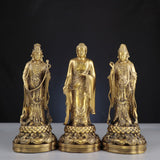
Western Three Saints 西方三圣 Copperware Buddhist Triad Set – 28–48cm | Amitabha Buddha, Guanyin & Mahasthamaprapta for Home Altar, Meditation Room & Cultural Decor


Western Three Saints 西方三圣 Copperware Buddhist Triad Set – 28–48cm | Amitabha Buddha, Guanyin & Mahasthamaprapta for Home Altar, Meditation Room & Cultural Decor
Western Three Saints 西方三圣 Copperware Buddhist Triad Set
A coordinated three-figure Buddhist display depicting the Western Three Saints / 西方三圣: Amitabha Buddha at the center, accompanied by Guanyin / Avalokiteshvara and Mahasthamaprapta / Dashizhi Bodhisattva. The set is presented on ornate lotus-and-cloud style bases with layered robes, jewelry details and traditional Chinese Buddhist sculptural styling.
Material: copperware.
Format: coordinated three-figure triad set.
Available Configurations
- Classic Gold-Tone – 28cm: approx. 11.5 × 10.5 × 28cm / set approx. 3kg
- Classic Gold-Tone – 38cm: approx. 38cm high
- Classic Gold-Tone – 48cm: approx. 48cm high
- Colored Finish 彩 – 28cm: approx. 28cm high
- Colored Finish 彩 – 48cm: approx. 48cm high
Who Are the Western Three Saints?
In Chinese Pure Land Buddhist tradition, the Western Three Saints are commonly represented as Amitabha Buddha together with Avalokiteshvara / Guanyin and Mahasthamaprapta / Dashizhi. The arrangement is one of the best-known devotional triads in East Asian Buddhist visual culture.
Classic Gold-Tone or Colored Finish?
Classic Gold-Tone creates a unified, traditional metallic presentation that works beautifully with dark wood, altar furniture and warm lighting. Colored Finish 彩 adds painted or colored detailing for a more vivid visual presence while retaining the same devotional triad theme.
Home Altar & Meditation Room
The 28cm set works well on a home altar, meditation-room cabinet, study credenza or dedicated Buddhist display shelf. The 38cm and 48cm sets have stronger architectural presence and are better suited to deeper altar furniture, larger meditation spaces or formal cultural-display areas.
If used devotionally, place the set according to your own Buddhist tradition and household practice. Keep the three figures on stable furniture with enough open space for the composition to read as one unified triad.
Interior Styling
For a calm New Chinese or contemplative interior, pair the copperware finish with dark walnut, rosewood-toned furniture, black lacquer, cream stone, linen, incense accessories, sutra books, calligraphy, celadon and restrained warm lighting.
Tea Room & Study Placement
The set can also be displayed in a quiet tea room or study when the space is used respectfully for reflection, reading or meditation. Position it away from splashing water, steam and unstable working surfaces.
Gift Guide
A meaningful cultural gift for Buddhist households, meditation practitioners, temple-art collectors, housewarmings, new meditation rooms, family altars and milestone occasions where the recipient already appreciates Buddhist imagery. Religious symbolism is personal, so it is best gifted with awareness of the recipient’s beliefs and preferences.
Spiritual Context
The triad carries devotional and symbolic meaning within Pure Land Buddhist traditions. Owning the set does not itself guarantee blessings, protection or spiritual outcomes; its significance belongs to personal belief, practice and cultural appreciation.
Care
Dust gently with a soft dry cloth or fine detailing brush. Avoid abrasive polishing compounds, corrosive chemical cleaners and prolonged moisture. Lift each figure from the body and base rather than projecting robe, crown or hand details. Use stable furniture sized appropriately for the combined set.
FAQ
Is this one statue or a set of three?
It is a coordinated set of three figures representing the Western Three Saints.
Who is in the center?
Amitabha Buddha is the central figure, traditionally accompanied by Guanyin and Mahasthamaprapta.
What does 西方三圣 mean?
It means “Western Three Saints,” a well-known Pure Land Buddhist triad in Chinese and East Asian Buddhist art.
What material is the set?
Copperware.
What is the difference between Classic Gold-Tone and Colored Finish?
The Classic version has a largely unified aged-gold appearance, while the Colored Finish version adds colored detailing for a more vivid presentation.
Which size is best for a home altar?
28cm is the easiest size for many home altars. The 38cm and 48cm sets need deeper, more substantial furniture and greater vertical clearance.
Does the set have to face a specific compass direction?
Practices vary by Buddhist tradition and household. Follow your own tradition and room layout.
Is this an antique?
No. It is a contemporary devotional-style copperware set.
Can it be placed in a tea room or study?
Yes, especially in a quiet cultural or contemplative display area.
Does owning the set guarantee blessings or spiritual results?
No. Religious and symbolic meanings should be understood within personal belief and practice rather than as guaranteed outcomes.