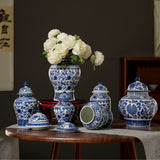
Jingdezhen Blue & White Floral Ceramic Jar & Vase Collection – 22 Classical Chinese Forms


Jingdezhen Blue & White Floral Ceramic Jar & Vase Collection – 22 Classical Chinese Forms
Jingdezhen Blue & White Floral Ceramic Jar & Vase Collection
A 22-style collection of blue-and-white decorative ceramic jars and vases inspired by the long visual tradition of Jingdezhen blue-and-white ware. The range includes lidded ginger jars, baluster jars, long-neck vases, Meiping-style forms, a double-gourd vase and compact accent vessels, giving customers a complete family of coordinated pieces for New Chinese, Chinoiserie and collected interiors.
Choose Your Form
- Lidded Slim Ginger Jar: H23 cm, belly 11 cm, mouth 6 cm.
- Tall-Neck Round Vase: H23 cm, belly 14 cm, mouth 8.5 cm.
- Lidded Round Temple Jar: H27 cm, belly 20 cm, mouth 10 cm.
- Lidded Baluster Jar Large: H30 cm, belly 17 cm, mouth 8 cm.
- Round-Neck Vase: H21 cm, belly 14 cm, mouth 5.5 cm.
- Low Lidded Jar: H10 cm, belly 12.5 cm, mouth 7.5 cm.
- Cylinder Open Jar: H20 cm, belly 11 cm, mouth 8 cm.
- Round Open Vase: H16 cm, belly 13 cm, mouth 6 cm.
- Lidded Cylinder Jar: H26.5 cm, belly 13.5 cm, mouth 9.5 cm.
- Pear-Neck Vase: H23 cm, belly 13 cm, mouth 6 cm.
- Lidded Square Jar: H17 cm, belly 12.5 cm, mouth 9 cm.
- Slim Cylinder Vase: H23 cm, belly 10.5 cm, mouth 7.5 cm.
- Double Gourd Vase: H21 cm, belly 11 cm, mouth 4 cm.
- Meiping Vase: H23 cm, belly 12 cm, mouth 4 cm.
- Open Ginger Jar: H20 cm, belly 14.5 cm, mouth 9.5 cm.
- Squat Open Jar: H16 cm, belly 13 cm, mouth 8 cm.
- Lidded Round Jar: H18 cm, belly 10 cm, mouth 5 cm.
- Long-Neck Round Vase: H21 cm, belly 13 cm, mouth 7 cm.
- Lidded Slim Cylinder Jar: H23 cm, belly 10 cm, mouth 7 cm.
- Low Round Vase: H15 cm, belly 12 cm, mouth 6.5 cm.
- Slim Floral Vase: H23 cm, belly 11 cm, mouth 5.5 cm.
- Lidded Baluster Jar: H22 cm, belly 12 cm, mouth 8 cm.
Craft & Surface Character
The collection uses a classic cobalt-blue-on-white decorative language with dense scrolling flowers, leaf tendrils, petal borders and geometric bands. The visual effect changes with the vessel form: broad jars give the pattern a rich tapestry-like surface, while slim-necked forms stretch the floral design vertically and feel lighter.
Lidded styles use fitted covers with small finials that complete the silhouette, while open forms can be used for branches and flowers. The glaze gives the pieces a smooth reflective finish that works especially well against dark wood, matte plaster and natural stone.
Blue-and-White Ceramic History
Jingdezhen became one of the most important centres of Chinese porcelain production, and cobalt-blue decoration on a white porcelain body developed into one of the most recognisable ceramic traditions in the world. Blue-and-white wares flourished through the Yuan, Ming and Qing periods and later travelled widely through international trade, influencing European Chinoiserie, Delftware and many later ceramic traditions.
Scrolling floral decoration suited porcelain especially well because cobalt linework could remain crisp beneath a transparent glaze. The limited blue-and-white palette also created a strong balance between ornament and negative space, which is one reason the style still integrates so easily into contemporary interiors.
These are contemporary decorative ceramics rather than antique pieces. Their value is in the combination of familiar historic forms, coordinated floral decoration and practical modern scale.
History of the Main Forms
Ginger & Temple Jars
Rounded covered jars became enduring decorative forms because their shoulders and lids created a complete architectural silhouette. In modern interiors they can be displayed empty, used as paired console pieces or mixed with open vases.
Meiping
The Meiping is one of the best-known Chinese vase forms, recognised by its high shoulders, narrow mouth and tapering lower body. It developed from functional storage vessels and later became a major decorative format.
Double Gourd
The double-gourd form uses two rounded sections stacked vertically. The gourd has long-standing auspicious associations in Chinese visual culture and is frequently used in decorative arts.
Long-Neck & Pear Forms
Longer-necked vases create vertical rhythm and are especially effective for sparse branches, making them natural choices for more restrained New Chinese interiors.
How to Style the Collection in a New Chinese Interior
Use Dark Wood as the Foundation
Walnut, dark elm, smoked oak and black lacquer make the cobalt decoration feel deeper and more refined. A single blue-and-white jar on dark wood can be enough to create a strong focal point.
Create a Three-Height Arrangement
Combine one tall 26–30 cm jar, one medium 20–23 cm vase and one low 10–18 cm accent piece. Keep the tallest piece slightly behind and avoid lining everything up symmetrically.
Add One Branch, Not a Dense Bouquet
Magnolia-style branches, plum-blossom-style stems, peonies, white roses and sparse greenery all work well. Leave enough of the porcelain body visible so the floral pattern remains part of the composition.
Mix Lidded and Open Forms
A lidded jar provides visual closure while an open vase introduces movement through flowers or branches. Mixing the two creates a more collected and less repetitive display.
Western Interior Pairing
Blue-and-white ceramics also work naturally in Grandmillennial, Chinoiserie, traditional, transitional and coastal interiors. Pair them with brass lamps, antique chests, rattan, cream upholstery, marble, blue textiles and patterned wallpaper.
Gift Guide
The 15–23 cm styles make versatile housewarming, birthday and host gifts because they are easy to place. Meiping and Double Gourd forms are especially suitable for design lovers interested in Chinese decorative history. Larger lidded jars make stronger wedding, anniversary and milestone gifts.
Care
Dust with a soft dry cloth. Wipe gently with a slightly damp cloth and dry promptly. Avoid abrasive cleaners, hard brushes and impact around lids and narrow rims. Use felt protection beneath the base on lacquer, polished timber and marble.
Frequently Asked Questions
How many styles are available?
There are 22 clearly named jar and vase forms.
Which style is tallest?
The Large Lidded Baluster Jar is approximately 30 cm high.
Which style is most compact?
The Low Lidded Jar is approximately 10 cm high and works well on small shelves.
Which styles are best for flowers?
Open Ginger Jar, Tall-Neck Round Vase, Slim Cylinder Vase and Long-Neck Round Vase are especially easy to arrange with flowers or branches.
Which styles are best displayed empty?
Lidded ginger jars, temple jars and baluster jars have complete silhouettes and look strong without flowers.
How should I style three pieces together?
Choose three different heights and body shapes, place the tallest behind, and leave open space between the pieces.
What flowers suit blue-and-white ceramics?
White roses, peonies, magnolia-style branches, plum-blossom-style stems and simple greenery all pair beautifully with cobalt blue.
Is this antique porcelain?
No. This is a contemporary decorative ceramic collection inspired by established blue-and-white traditions and classical Chinese forms.
What does the double-gourd form represent?
The gourd has long been used as an auspicious motif in Chinese decorative culture and is associated with longevity, protection and abundance.
Can I mix these pieces with Western decor?
Yes. Blue-and-white ceramics integrate especially well with traditional, Grandmillennial, coastal and transitional rooms.
Which style makes the easiest gift?
A 20–23 cm open vase or medium lidded jar is the safest all-purpose size for gifting.
How do I make the display look more luxurious?
Use fewer objects, vary height, repeat cobalt blue elsewhere in the room and leave visible negative space around the ceramics.