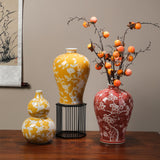
Chinese Ceramic Vase Collection – Blue & White, Yellow and Wine Red in 10 Classical Forms


Chinese Ceramic Vase Collection – Blue & White, Yellow and Wine Red in 10 Classical Forms
Chinese Ceramic Vase Collection – 10 Classical Forms
A richly varied decorative ceramic collection combining blue-and-white floral painting with full-colour yellow and wine-red botanical finishes. Ten clearly named vessel forms range from a tall Willow Leaf Vase and sculptural Phoenix Tail forms to Meiping, Double Gourd, Full Moon and Winter Melon silhouettes, making the collection easy to style individually or as a layered New Chinese display.
Choose Your Form
- Willow Leaf Vase — Blue & White: approximately W20 × H43 cm.
- Large Belly Vase — Blue & White: approximately W17.5 × H26.5 cm.
- Square Flat Vase — Blue & White: approximately W12.5 × H30 cm.
- Winter Melon Vase — Blue & White: approximately W17.5 × H27.5 cm.
- Full Moon Vase — Blue & White: approximately W26 × H27 cm.
- Phoenix Tail Vase — Two-Sided Blue & White: approximately W17.5 × D8.5 × H36.5 cm.
- Phoenix Tail Vase — Blue & White: approximately W17.5 × D8.5 × H36.5 cm.
- Meiping Vase — Imperial Yellow: approximately W21 × H32 cm.
- Meiping Vase — Wine Red: approximately W21 × H32 cm.
- Double Gourd Vase — Imperial Yellow: approximately W18.5 × H28 cm.
Craft & Surface Character
The blue-and-white pieces use cobalt-style floral, bird and scrolling botanical decoration across pale ceramic bodies. Each silhouette changes how the pattern reads: the Willow Leaf Vase stretches the decoration vertically, the Full Moon Vase provides a broad rounded field, and the flat Phoenix Tail forms place emphasis on front-facing composition.
The yellow and wine-red pieces reverse the visual balance by using a strong coloured ground with pale botanical imagery. Their richer palette makes them natural focal points when mixed with neutral furniture, dark timber and restrained accessories.
Chinese Vessel Forms & Decorative History
Many of the shapes in this collection draw from long-established Chinese ceramic vocabulary. The Meiping form is known for its high shoulders and narrow neck; the Double Gourd uses stacked rounded volumes with long-standing auspicious associations; the Full Moon and rounded-belly forms create generous circular surfaces for painted decoration; and the Willow Leaf silhouette is valued for its slender vertical rhythm.
Phoenix Tail forms introduce a more architectural profile with a flattened body and decorative crown-like upper contour. The two-sided version is especially effective where the vase can be viewed from multiple angles.
These are contemporary decorative ceramics rather than antique vessels. Their appeal comes from combining recognisable Chinese vessel silhouettes with strong colour, botanical imagery and proportions that work in modern homes.
How to Style the Collection in a New Chinese Interior
Use one tall form as the anchor
The 43 cm Willow Leaf Vase is ideal at one end of a long console, beside framed artwork or near a table lamp. Keep the surrounding accessories lower so the vertical silhouette remains dominant.
Build a three-vase composition
Combine one tall shape, one rounded shape and one low or flat form. A strong combination is Willow Leaf + Full Moon + Square Flat Vase. Offset the pieces rather than lining them up symmetrically.
Mix blue and colour carefully
Use one Imperial Yellow or Wine Red piece as the accent, then support it with one or two blue-and-white forms. This creates contrast without turning the display into a crowded colour mix.
Pair with dark timber and stone
Walnut, dark elm, black-stained oak, travertine and pale stone all provide a strong backdrop. Blue-and-white forms look crisp on dark wood, while yellow and wine red become especially vivid against cream walls and stone surfaces.
Flower & Branch Styling
For Willow Leaf, Phoenix Tail and Meiping forms, use long dry branches, magnolia-style stems, plum-blossom-style branches or sparse greenery. Full Moon and Large Belly forms work well displayed empty or with shorter arrangements. The Double Gourd form is strongest as a standalone sculptural piece because its stacked silhouette is already visually active.
Western Interior Pairing
The collection also suits Chinoiserie, Grandmillennial, traditional, transitional and eclectic interiors. Pair blue-and-white pieces with brass, antique wood and patterned textiles. Use the yellow pieces with warm neutral rooms and the Wine Red Meiping with darker wood, cream upholstery and framed art.
Gift Guide
Willow Leaf and Phoenix Tail are statement gifts for design lovers. Meiping is ideal for someone interested in classical Chinese forms. Full Moon is a versatile housewarming choice, while Imperial Yellow Double Gourd makes a distinctive symbolic and decorative gift.
Care
Dust with a soft dry cloth. Wipe gently with a slightly damp cloth and dry promptly. Avoid abrasive cleaners and hard impacts. Use felt protection beneath the base on lacquer, marble or polished timber.
Frequently Asked Questions
How many variants are available?
Ten clearly named vase forms and colour treatments are available.
Which vase is tallest?
The Blue & White Willow Leaf Vase is the tallest at approximately 43 cm.
Which vase is widest?
The Full Moon Vase is approximately 26 cm wide and creates the broadest rounded silhouette.
Which forms are best for branches?
Willow Leaf, Phoenix Tail and Meiping are especially suited to longer, more vertical branches.
Which forms work best displayed empty?
Full Moon, Double Gourd, Large Belly and the flat Phoenix Tail forms all have strong enough silhouettes to display without flowers.
What is special about the two-sided Phoenix Tail Vase?
Its flattened body presents decorative surfaces on both sides, making it useful on open shelving, consoles and locations where it can be seen from different directions.
Is this antique Chinese porcelain?
No. This is a contemporary decorative ceramic collection inspired by classical Chinese vessel forms and floral decorative traditions.
Which colour is easiest to style?
Blue and white is the most versatile across Chinese-inspired and Western interiors. Imperial Yellow and Wine Red create stronger focal points.
Which vase makes the best housewarming gift?
Full Moon, Large Belly and Meiping are all easy to place and visually distinctive without requiring a very large room.
How do I create a New Chinese display?
Choose one dominant vase, add one or two lower companion pieces, use dark wood or stone beneath them, keep the branch arrangement asymmetrical and leave visible negative space around the group.
Can I mix the yellow and red pieces with blue-and-white ceramics?
Yes. Use only one strong-colour piece in the main grouping and let blue-and-white ceramics provide the quieter visual structure around it.